
Conditions ·Foot & Ankle Fractures
A break treated right is a break that heals right.
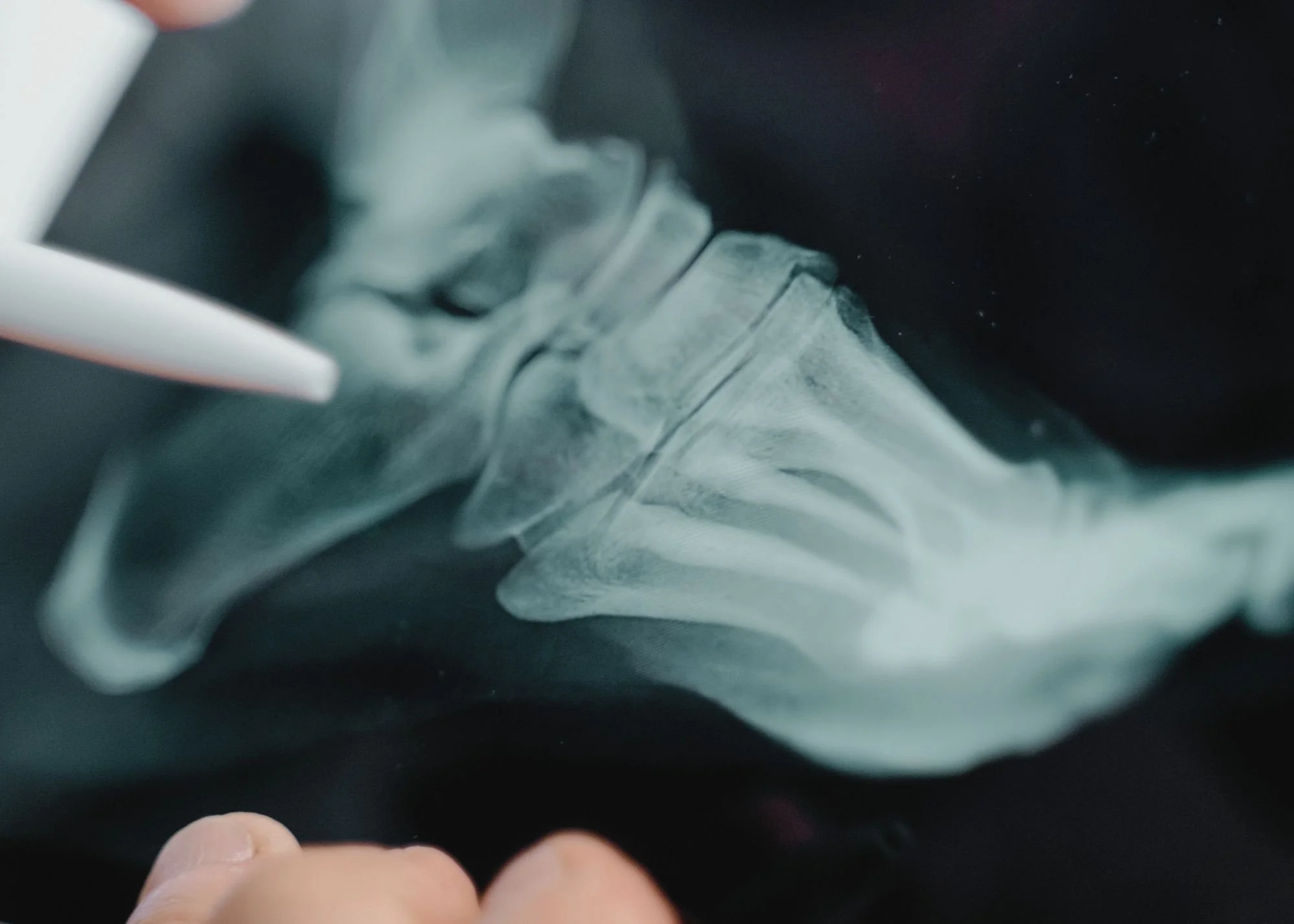
Foot and ankle fractures range from minor toe fractures that heal on their own to complex ankle breaks requiring surgery and months of rehabilitation. Accurate diagnosis, immediate stabilization, and a treatment plan matched to the specific fracture pattern make all the difference in long-term outcomes.
Wheat Ridge
⛰
Boulder
⛰
Arvada
⛰
Lakewood
⛰
Golden
⛰
Edgewater
⛰
Louisville
⛰
Lafayette
⛰
Superior
⛰
Broomfield
⛰
Erie
⛰
Longmont
⛰
Wheat Ridge ⛰ Boulder ⛰ Arvada ⛰ Lakewood ⛰ Golden ⛰ Edgewater ⛰ Louisville ⛰ Lafayette ⛰ Superior ⛰ Broomfield ⛰ Erie ⛰ Longmont ⛰

THE PROBLEM
Twenty-eight bones. Many ways to break one.
The foot and ankle contain twenty-eight bones, and any of them can fracture. The most common patterns include lateral malleolus fractures (the outside of the ankle), metatarsal fractures (the long bones in the midfoot), stress fractures from repetitive impact, and toe fractures from direct trauma.
What complicates fractures is that they don't always announce themselves clearly. Patients walk on broken bones for days or weeks, assuming the injury is "just a sprain." Some fractures, particularly stress fractures and Lisfranc injuries, don't appear on initial X-rays and require advanced imaging or repeat studies to identify.
COMMON SYMPTOMS WE LOOK FOR
-Severe pain with weight-bearing. Pain that's significantly worse than a typical sprain, often with inability to bear weight.
-Visible deformity. Any obvious change in the shape or alignment of the foot or ankle.
-Rapid significant swelling. Swelling that develops within minutes and continues for hours.
-Bony point tenderness. Sharp pain when direct pressure is applied to a specific bony landmark.
How We Treat It
From stable hairlines to complex reconstructions.
Most foot and ankle fractures heal well with appropriate non-surgical management — casting or walking boot immobilization, protected weight-bearing, and gradual return to activity. Stable toe fractures often respond to buddy taping and protective footwear alone.
Our podiatrists in Wheat Ridge and Boulder use in-office digital X-ray to diagnose most fractures the same day you walk in. When more detail is needed, we coordinate MRI or CT imaging and develop a treatment plan based on the specific fracture pattern.
For displaced fractures, unstable patterns, and certain athletic injuries like Jones fractures, surgical fixation with modern small-implant techniques produces faster healing and more reliable return to activity. Our surgical team performs ankle fracture fixation, midfoot reconstruction, and complex repair when warranted.
Recovery from any fracture requires patience. Returning to activity too quickly is the most common cause of refracture or non-healing — and we coordinate every milestone to make sure you're healing on track.
TREATMENT OPTIONS WE OFFER FOR foot and ankle fractures
— Casting & Walking Boots
— Buddy Taping & Splinting
— Stress Fracture Management

🏆 Best of Mile High 2023
🏆 Best of Mile High 2025
🏆 Best of Mile High 2024
⭐ Nextdoor Neighborhood Fave
Voted Best Podiatrist in the Best of Mile High — three years running.
RECOGNITION
We've been honored to be voted Best Podiatrist in the Best of Mile High in 2023, 2024, and 2025, and we've been named a Neighborhood Fave by Nextdoor. We've also earned a 4.8-star rating from more than 1,300 patients across our two offices. We mention this because we're proud of it — but also because those ratings are built one visit at a time, by real patients who took the time to say something. We don't take that lightly.
how it works
Three steps to walking without pain again.
The path from your first phone call to lasting relief is simpler than most patients expect — and we'll walk you through every part of it.
STEP 1
Call to schedule
Pick the office that's most convenient — Wheat Ridge or Boulder — and call to book. New patients are always welcome, and most insurance plans are accepted.
01
STEP 2
Come in for a thoughtful evaluation
Your first visit is a conversation, not a conveyor belt. We listen to your history, examine what's going on, and use in-office digital X-rays or musculoskeletal ultrasound if we need a closer look.
02
STEP 3
Start a plan built around you
You'll leave understanding your condition, your options, and exactly what the next step looks like. No pressure, no upsell — just steady care.
03
Related Resources
Keep reading from our patient education library.
Treatment Service
Foot & ankle surgery
Our surgical team performs the full range of fracture fixation when surgery is the right answer.
Blog ·Surgery
Foot & ankle surgery: when it's the right choice and what to expect
An honest look at when surgical fixation makes sense and what realistic recovery looks like.
Treatment Service
Sports medicine
Active patients with stress fractures benefit from coordinated training and recovery planning.
Blog ·Recovery
Achilles tendon pain in runners: causes, symptoms, and treatment
Stress fractures and Achilles issues often coexist in runners. Here's how to tell what's what.
Related Condition
Ankle sprains
Many fractures are misdiagnosed as sprains initially. Learn the differences and why accurate diagnosis matters.
Blog · Deep Dive
Foot and ankle fractures: broken ankles, broken toes, and what to do
A complete guide to fracture types, recovery timelines, and when surgery is necessary.
ANSWERS TO COMMON QUESTIONS
What patients ask about foot & ankle fractures.
-
Suspected fractures typically involve severe pain that's worse with weight-bearing, inability to walk normally, visible deformity, rapid significant swelling, and tenderness directly over a bone rather than soft tissue. Imaging confirms the diagnosis.
Sprains and fractures share many symptoms, which is why imaging is often necessary to distinguish them. The Ottawa Ankle Rules suggest imaging should be obtained for any ankle injury where the patient cannot bear weight for four steps immediately after the injury and at the time of evaluation. When in doubt, get imaging — missing a fracture and treating it as a sprain can lead to non-healing and long-term problems.
-
Recovery varies dramatically by injury. Stable toe fractures heal in 3 to 6 weeks. Most metatarsal fractures take 6 to 8 weeks. Stable ankle fractures heal in 6 to 8 weeks of immobilization plus 2 to 4 months of full recovery. Surgical ankle fractures often require 6 to 12 months for complete recovery.
Stress fractures typically need 6 to 8 weeks of relative rest, then a gradual return to running or impact activities over 4 to 6 additional weeks. Returning to activity too quickly is the most common cause of refracture or non-healing — patience during recovery pays off. We coordinate every milestone to keep healing on track.
-
Many ankle fractures heal well without surgery, particularly stable, non-displaced patterns. Displaced or unstable fractures, bimalleolar and trimalleolar fractures, open fractures, and certain Jones fractures in athletes typically require surgical fixation to heal correctly.
The decision depends on the specific fracture pattern, displacement, joint involvement, and patient factors like activity level and overall health. Modern fracture surgery uses small plates and screws to restore alignment, allowing for predictable healing. Recovery typically involves weeks of non-weight-bearing followed by progressive return to activity over months. Our surgical team will walk you through whether your specific fracture is a candidate for non-surgical management or whether surgery is the right path.
-
A stress fracture is a small, hairline crack in the bone caused by repetitive impact rather than acute trauma. Stress fractures most commonly affect the metatarsals or calcaneus and are common in runners, dancers, and military recruits who increase activity too quickly.
Stress fractures often don't appear on initial X-rays and may require MRI or bone scan for diagnosis. Treatment involves rest from impact activities, a walking boot or modified footwear, and gradual return to running. Patients who try to push through stress fractures often progress to complete fractures requiring surgical fixation. If you're a runner with persistent localized pain that builds with mileage, get evaluated.
-
Yes, most major insurance plans fully cover foot and ankle fracture diagnosis, treatment, and surgical care when warranted. Table Mountain Foot & Ankle accepts most major insurance plans, Medicare, and workers' compensation.
Coverage typically includes office visits, imaging, casting or walking boots, surgical procedures and anesthesia, and follow-up care. For workers' comp injuries, we coordinate directly with your employer and adjuster. Our front office team verifies benefits before treatment so there are no surprises.

READY WHEN YOU ARE
Call to schedule your visit.
We see patients from across the Denver metro area at our Wheat Ridge and Boulder offices. Both locations are accepting new patients, and both offer free parking. Call whichever office is most convenient — we'll take it from there.